
What Is Geothermal Heating with a Heat Pump?
A few meters below ground level, the temperature remains relatively constant throughout the year (in Romania, usually around 10–15°C). Geothermal systems take advantage of this: through vertical drilling and a specialized heat pump, the building “borrows” heat from the ground in winter and transfers excess heat back into the soil in summer.
In practical terms, a geothermal heat pump does not “generate” heat through combustion like a gas boiler does. Instead, it moves heat between the building and the ground, using a relatively small amount of electricity. This is where the significant savings come from.
For a residential complex, a hotel or guesthouse, and even for a single-family home, a geothermal system can become the backbone of the heating and cooling installation, ensuring high thermal comfort and predictable long-term operating costs.
How Does a Vertical Drilling System for a Heat Pump Work?
For a geothermal heat pump to operate efficiently, it needs a closed-loop heat exchange circuit with the ground. This circuit is created through vertical geothermal drilling, where special ground probes are installed.
In short, the process works like this:
- the team performs vertical drilling, usually at depths between 50 and 150 m, depending on the project and site conditions;
- geothermal probes are inserted into the boreholes (looped polyethylene pipes), through which a heat-transfer fluid circulates;
- the fluid absorbs heat from the ground in winter and transfers it to the heat pump; in summer, the process is reversed;
- the heat pump raises or lowers the temperature as needed and distributes it through the building installation system, such as underfloor heating, fan coils, or low-temperature radiators.
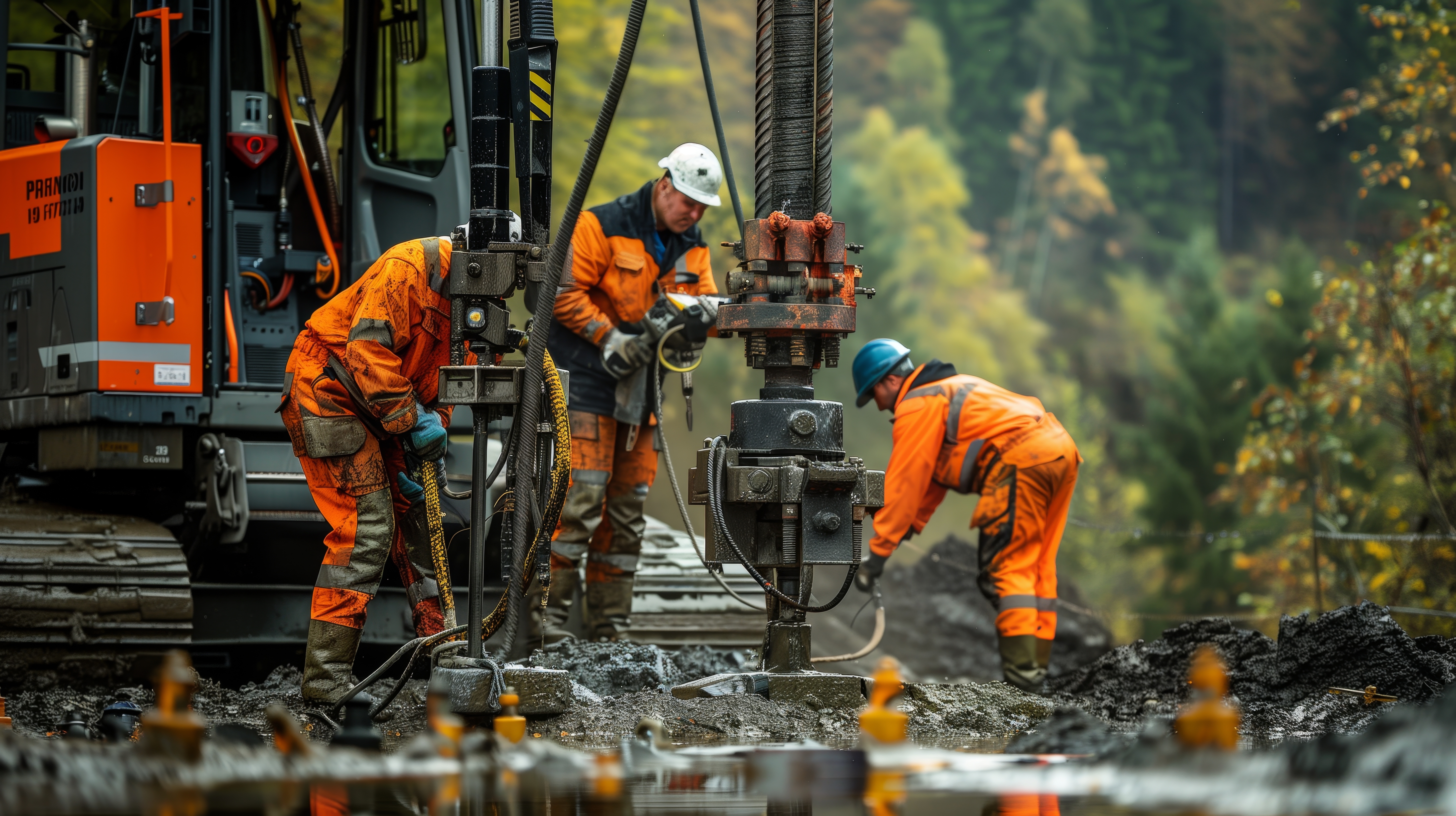
From a land-use perspective, vertical drilling is compact: the entire “energy plant” is stored underground, while the surface remains available for parking, green areas, or other project functions.
Main Stages for Executing Heat Pump Drilling
In order for a geothermal system to be safe and efficient, drilling is not just about boring into the ground. Every project goes through a set of clear technical stages.
1. Geotechnical study and thermal sizing
Before any drilling begins, the Dromcons team analyzes the soil structure, groundwater level, and local geological conditions. At the same time, the required heat pump capacity and the number of needed boreholes are calculated according to the surface area and purpose of the building.
2. Designing and setting out the drilling layout
The exact drilling positions on site are established while taking into account the building layout, existing utility networks, and long-term operating requirements. Dromcons surveyors ensure that the setting out process follows the design and all applicable technical standards.
3. Drilling execution and installation of geothermal probes
Next comes the actual drilling phase, using specialized equipment adapted to the soil type. At the designed depth, the geothermal probes are installed, and sealing and filling works are carried out in order to ensure optimal thermal contact with the ground.
4. Connection to the heat pump and the building installation
The pipes from the boreholes are connected to manifolds and then to the heat pump, which is integrated into the building’s heating and cooling system. At this stage, the system is ready for testing and commissioning.
Benefits of Geothermal Heating Compared to Traditional Solutions
Why are more and more developers and property owners choosing geothermal drilling for heat pumps instead of gas boilers or conventional electric heating? Because the advantages are very concrete.
Significant savings on energy bills
Geothermal systems use 50–70% less energy than many traditional solutions. An office building that pays 10,000 RON per month for gas heating may reduce that cost to around 3,000–4,000 RON after implementing a geothermal system.
The efficiency of a heat pump is measured through COP (Coefficient of Performance). For geothermal systems, the COP can reach 3–5. In other words, for every 1 kWh of electricity consumed, the system can deliver 3–5 kWh of thermal energy.
Reduced dependence on gas prices
By using energy stored in the ground, buildings become less dependent on gas and fossil fuel price fluctuations. In the medium term, the investment is usually recovered through monthly savings, often within 5–8 years, depending on consumption.
A sustainable solution with lower CO₂ emissions
Geothermal systems do not produce direct CO₂ emissions during operation. They use a renewable resource — the heat stored in the ground — and support energy-efficiency and environmental protection goals at European level.
When Is a Geothermal Heat Pump with Drilling Worth the Investment?
Not every project has the same requirements. Still, there are several situations where geothermal drilling with a heat pump becomes especially attractive:
- you are building a residential complex that you want to position as a green development with low maintenance costs;
- you own a hotel, guesthouse, or leisure complex where energy bills represent a major part of operating costs;
- you manage office buildings and want to offer tenants predictable costs and a high level of thermal comfort;
- you are building a new home and want to avoid chimneys and gas installations, choosing from the start a low-emission solution.
In the article “From Water to Free Energy – How Drilling Can Transform Your Project” you can also see other types of drilling which, when combined with geothermal systems, can increase your project’s energy independence.
Project Examples and Situations Where Geothermal Drilling Is Used
In the Dromcons portfolio, heat pump drilling often appears together with geotechnical studies and water drilling, especially in projects that aim for both energy independence and access to local resources.
For example, in a residential complex, geothermal drilling can be used to heat and cool apartment buildings, while water drilling can provide a source for irrigation and landscaped areas. In the case of a guesthouse or hotel, a geothermal system helps maintain constant thermal comfort for guests, with much lower long-term operating costs.
Even in industrial or logistics projects, where halls have large surface areas and require temperature control, vertical geothermal drilling can become a stable and efficient solution, especially when correctly sized based on field studies.
Why Choose Dromcons for Vertical Drilling and Geotechnical Studies?
A high-performance geothermal system starts with correctly executed drilling. This is where Dromcons experience makes the difference.
- More than 20 years of experience in geotechnical studies, drilling, road and bridge design, and topographic surveying.
- Multidisciplinary team – geotechnical engineers, designers, surveyors, and drilling technicians working in an integrated way.
- Modern equipment and an in-house laboratory for testing soil and water samples, which supports correct sizing of the geothermal system.
- Nationwide coverage – we respond quickly throughout Romania, for both public and private projects.
If you are interested in other ways drilling can support your projects, we also recommend the article “Why More Property Owners Choose Geothermal Heating Through Drilling” .
Conclusions: Heat Pump Drilling – A Smart Investment in Your Building’s Future
Vertical drilling for geothermal heat pumps is not just a trend. It is a mature technical solution already widely used across Europe. It reduces energy consumption, limits dependence on gas, protects the environment, and increases the long-term value of the building.
With a specialized partner such as Dromcons, the design and execution of geothermal drilling becomes a clear, controlled, and predictable process, from site investigation to system commissioning.
Would you like to find out whether a geothermal system is suitable for your project? Send us a few details about the building, area, and intended use, and the Dromcons team can propose a technical solution and a cost estimate.
Contact Us for a Custom Analysis and Offer